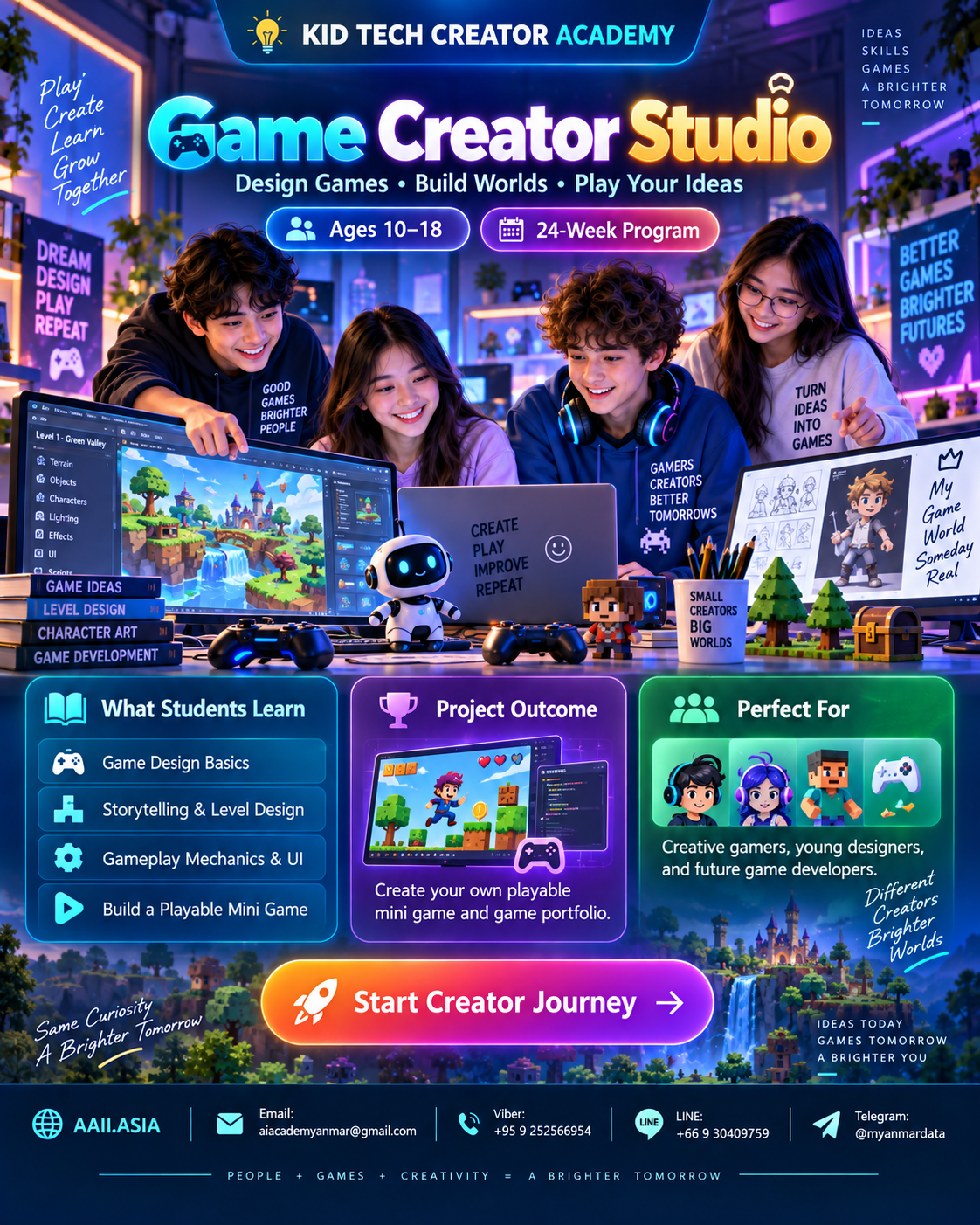
WHAT STUDENTS LEARN
Six Interactive Learning Modules
Click each module card to open more detail. Every module combines guided learning, practice, creation and review.
MODULE 01
Game Design Basics
Genres, goals, rules, feedback loops and player motivation.
Learning Focus
Genres, goals, rules, feedback loops and player motivation.
Click again to collapse
MODULE 02
Logic & Mechanics
Movement, scoring, collisions, conditions and game states.
Learning Focus
Movement, scoring, collisions, conditions and game states.
Click again to collapse
MODULE 03
Level & World Design
Maps, difficulty curves, pacing, checkpoints and challenges.
Learning Focus
Maps, difficulty curves, pacing, checkpoints and challenges.
Click again to collapse
MODULE 04
Art, UI & Audio
Characters, visual style, interface, sound and game feel.
Learning Focus
Characters, visual style, interface, sound and game feel.
Click again to collapse
MODULE 05
Testing & Improvement
Playtesting, bug reports, balancing and iteration.
Learning Focus
Playtesting, bug reports, balancing and iteration.
Click again to collapse
MODULE 06
Publish & Showcase
Polish, instructions, trailer and final game presentation.
Learning Focus
Polish, instructions, trailer and final game presentation.
Click again to collapse